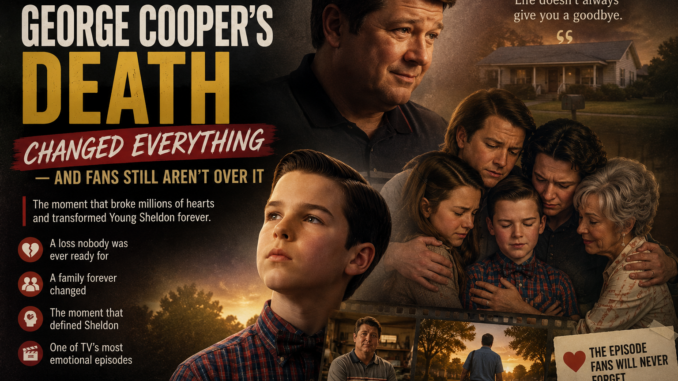
For most of its seven-season run, Young Sheldon was known as a lighthearted family comedy. It followed the adventures of an extraordinary child growing up in an ordinary Texas family, balancing laugh-out-loud humor with touching family moments. Even though longtime fans of The Big Bang Theory knew George Cooper’s fate had already been established years earlier, many secretly hoped the prequel would somehow rewrite history.
It never did.
Instead, Young Sheldon embraced one of the boldest creative decisions in modern television, delivering an episode that permanently transformed the series—and left millions of viewers heartbroken.
More than two years after the finale aired, fans continue to revisit the episode, discuss its emotional impact, and call it one of the greatest moments in the history of the franchise.
Everyone Knew It Was Coming—But Nobody Was Ready

From the very first season, audiences understood that George Cooper’s story carried a tragic ending.
Adult Sheldon had repeatedly mentioned in The Big Bang Theory that his father died while he was still a teenager. That piece of history became one of the biggest emotional shadows hanging over the prequel.
Yet as Young Sheldon progressed, something unexpected happened.
George Cooper became one of the show’s most beloved characters.
Played with remarkable warmth and humanity, George was no longer simply the flawed father Sheldon often remembered. He became a devoted husband trying to save his marriage, a caring father struggling to understand his brilliant son, and the emotional anchor holding the Cooper family together.
That transformation made the inevitable tragedy infinitely more painful.
The Episode That Changed Everything
The moment itself wasn’t built around dramatic speeches or shocking twists.
Instead, the writers chose something much more powerful: realism.
George leaves home for what seems like another ordinary day.
Then, without warning, the Cooper family receives devastating news.
There is no opportunity for a final goodbye.
No emotional farewell.
No heroic last conversation.
Life simply changes forever.
That quiet approach made the episode feel painfully authentic, reminding viewers how unexpected loss often happens in real life.
Every Member of the Cooper Family Was Changed Forever
George’s death wasn’t just about one character leaving the series.
It reshaped every member of the Cooper family.
Mary suddenly found herself raising three children without her husband while trying to hold the family together despite overwhelming grief.
Missy, who had always shared a special bond with her father, struggled with feelings she was too young to fully understand.
Georgie stepped into adulthood almost overnight, accepting responsibilities that would ultimately shape the man audiences later heard about in The Big Bang Theory.
Even Meemaw, usually the family’s strongest source of humor, revealed a level of vulnerability fans had rarely seen before.
And then there was Sheldon.
For perhaps the first time in the series, viewers saw a young genius confronted by something no amount of intelligence could solve.
The Writers Refused to Change History
Many television series choose to rewrite established continuity when audiences become attached to certain characters.
The writers of Young Sheldon made the opposite decision.
Despite knowing how much viewers loved George Cooper, they honored the timeline established years earlier in The Big Bang Theory.
It was a risky choice.
Social media exploded with emotional reactions after the episode aired. Some fans admitted they cried throughout the entire episode. Others praised the writers for respecting the franchise’s history rather than offering an unrealistic happy ending.
That commitment to storytelling gave the finale a level of emotional honesty rarely seen in sitcoms.
The Moment That Redefined Sheldon Cooper
One of the greatest achievements of the episode is how it deepened audiences’ understanding of Sheldon himself.
For years, adult Sheldon often appeared emotionally distant and socially awkward.
Young Sheldon finally showed why.
The sudden loss of his father became one of the defining experiences of his childhood, helping explain many of the emotional walls audiences had seen throughout The Big Bang Theory.
Instead of changing Sheldon’s story, the prequel completed it.
Fans Still Talk About It Today
Even years after the series finale, George Cooper’s death remains one of the most discussed moments in the franchise.
Reaction videos continue to attract millions of views.
Fan forums regularly revisit the episode.
Many viewers describe it as one of the rare television moments that genuinely caught them off guard—not because they didn’t know it would happen, but because they underestimated how deeply the writers would make them care.
That emotional connection is ultimately what transformed Young Sheldon from a successful sitcom into a truly unforgettable family drama.
Final Thoughts
Every great television series has one defining moment that audiences remember forever.
For Young Sheldon, it wasn’t a scientific breakthrough or one of Sheldon’s clever jokes.
It was the heartbreaking loss of George Cooper.
The episode reminded viewers that behind every genius is a family, behind every success is sacrifice, and behind every memory is someone who helped shape the person we eventually become.
Years later, fans still aren’t over George Cooper’s death.
And perhaps that’s the greatest compliment the writers could ever receive.