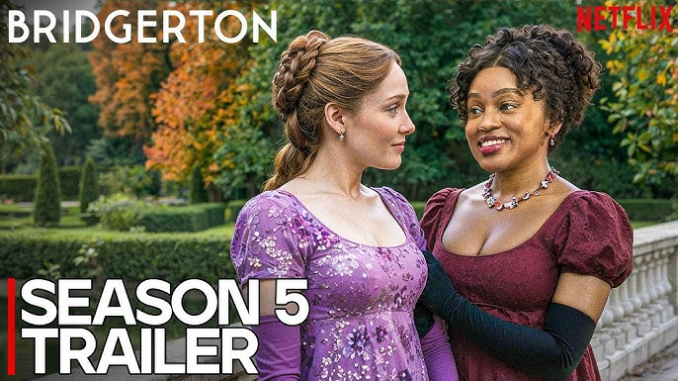
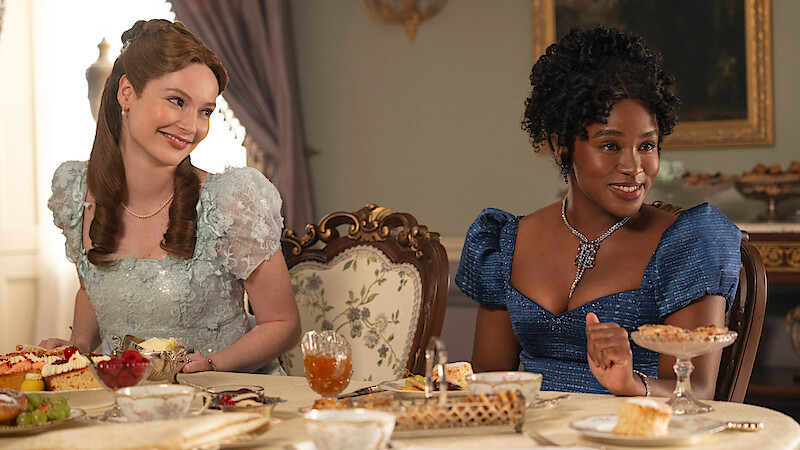
Lash-outs against Bridgerton have become de rigueur several seasons into the show. So far, the complaints have run the gamut from racism to fat phobia to misogynoir to homophobia and beyond. The latest kerfuffle, according to some critics, is that sapphic love in Bridgerton is “anachronistic, ” and that the show’s planned depiction of a romance between Francesca (Hannah Dodd) and Michaela (Masali Baduza) in the forthcoming fifth season is “historically inaccurate.” This is, once again, utter balderdash, but opinion without proof makes for a tedious argument, so let’s look at some facts about sapphic history, shall we?
Before I begin, I will confess to a past as a literature teacher. Worse still, I will own that I am obsessed with the history of interesting women, and Anne Lister — the source material for television’s other Regency lesbian tale, Gentleman Jack — is one of my personal “history crushes.” Over the past few years, I’ve written three different books in three different genres that borrow influence from said crush (fantasy novel Remedial Magic, contemporary romance Toni and Addie Go Viral, and my upcoming Regency fantasy A Treason of Magic). Assertive women who defy convention have always fascinated me , and a well-dressed woman who keeps a lusty diary? Swoon.
So the easiest fact to put on record is that women who love women are, in fact, quite historically accurate for both our Bridgerton baddies — and for the centuries before and after them, too. We have always existed, and our existence has regularly irritated those people threatened by women, especially by tribades or any person who lived without the leashes of patriarchy.
Let’s start a smidge earlier than Regency to emphasize the point. The words “lesbian” and “tribadism” were both used in the late 16th century in Seigneur Brantôme’s Dames Galantes (translated, The Lives of Fair and Gallant Ladies), a collection of narratives detailing the lives of women at court in Renaissance Italy, including relations between women:
We were certainly here, at least a full two centuries before the Bridgerton era!
Not shockingly in a patriarchal society, those narrow-minded souls who wished we weren’t here now were also around back then. A half century after Brantôme’s Dames Galantes, Ludovico Maria Sinistrari (an Italian priest and author) also references us, but this time in the context of death by burning. At the time, there was some confusion about what so-called “female sodomy” was. Women could be executed “if they used artificial instruments” intimately, but Sinistrari, unlike other jurists, argued “that the crime could occur only if one woman possessed a clitoris long enough to penetrate another.” The poor monks were confused, but they were certain that we were doing something they deemed wrong enough to burn us.
In short, we were here, both admired and reviled, centuries before the Regency era. So perhaps the next step is to look at arrest records. Trying to find us in the past requires a wider look than the obvious places. Less than twenty years before when Bridgerton would have taken place is this arrest:
Wiebes was far from the only arrest. Memoirs, arrests, letters — these are all places to find proof of our collective history. The dearth of easily found stories isn’t indicative of our absence, but of threats against our safety. If one widens the search to women who lived and dressed as men — sometimes for love, sometimes for financial freedom, and sometimes, perhaps, as an expression of a trans identity they could not express — the number of stories increases. Which leads us back to Anne Lister.
Currently, many people know Anne Lister (1791-1840) from the fictionalization of her life in the BBC One and HBO show Gentleman Jack. Lister had a measure of safety because she was a member of the landed class. She wore less-gendered clothing, but not traditionally male clothing. In a journal entry from 1817, she notes: “I took off my pelisse & drawers, got into bed & had a very good kiss, she showing all due inclination & in less than seven minutes the door was unbolted & we were all right again.”
When we categorize where she fits in our modern list of terms, we run into an obvious complication. In Lister’s own diaries — which run more than 4 million words! — she self-defines as a woman, and one who loves women exclusively. Through her own words, she has aligned herself as not-bisexual. She is also very much not asexual. Some critics clarify that Lister used the word “kiss” to mean “orgasm.” In other words, she stripped out of her garments for a quickie — a seven- minute experience that ended in orgasm.
I suspect many women like Lister — the lusty sort who pause in a room for a quick hook-up — are still frequenting modern dating. Some things don’t change, and that’s rather my point. Would her choice of label change in modern life? We can’t answer that, but I am inclined to respect her pronouns as much as I would yours. She presents as a rather masc butch lesbian woman.

There were, of course, lesbian elders back then, too. Lister visited the “ladies of Llangollen,” Lady Eleanor Butler & Miss Ponsonby, who set up house together in Wales where they lived together for half a century. Eleanor Butler “was described in a local paper as ‘tall and masculine… and appears in all respects as a young man, if we except the petticoats which she still retains.’” Ponsonby was depicted as more femme, although both women cropped their hair shorter after they moved to Wales together. Unlike Lister, they do not overtly address intimate matters in their own writing, but they did chronicle their affection and love for each other.
The ladies were contemporaries of Lister and of Bridgerton. In fact, they exchanged letters with Queen Charlotte, who visited them in Wales. On her advice, the king granted the Ladies of Llangollen a pension. Yes, an actual character in Bridgerton visited Butler and Ponsonby, two women who lived together for half a century and were buried together.
Only a fool would endorse the suggestion that a loving relationship between women who defied social standards is anachronistic. Ask Anne Lister, who wrote of multiple liaisons with women in her extensive diaries, or look at the letters and journals of the ladies of Llangollen, or ask the queen who befriended them.
We have always been here.