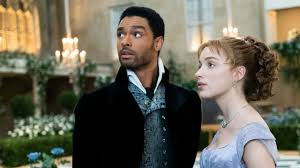
It is a truth universally acknowledged that any love story between two English people in period costumes must be compared to a Jane Austen novel . Bridgerton , the new Netflix series set in 19th – century London high society but featuring a diverse cast, a pop aesthetic, and plenty of sex scenes, is no exception and has been described as a modern take on the British author’s classics.
Like Jane Austen’s novels, Bridgerton is set during the English Regency era (specifically in 1813, the year Pride and Prejudice was published ). And like Austen’s novels, the series tells a love story punctuated by balls, social conventions, Empire-waist dresses, and misunderstandings.
But with its delightfully ridiculous plot twists, its meaningless storylines, and its candlelit sex scenes, the series is more reminiscent of Harlequin romances and the love stories of Barbara Cartland or Danielle Steel , given the Netflix treatment, than the biting and subtle social commentary of Jane Austen. (I should mention here that I devoured the series in less than 24 hours, and I have no regrets.)
A heroine who only exists through her love story

Bridgerton is, in fact, an adaptation of a series of romantic novels of the same name, written between 2000 and 2013 by the American author Julia Quinn (the first season follows the plot of the first book, Daphne and the Duke ). And if the plot seems predictable, it’s because these novels are part of a long tradition of sentimental stories.
The English Regency, which lasted less than ten years, is one of the most fantasized periods in Romantic literature (surely thanks to the influence of, you guessed it, Jane Austen).
A classic trope of romance novels, the hero ( Regé-Jean Page ) is a very handsome duke, a confirmed bachelor who has sworn never to marry. Of course, he has a somewhat dark (though not too dark) and mysterious past, and more daddy issues than a verse of “Papaoutai”.
Daphne ( Phoebe Dynevor ), the heroine, is pretty without being intimidating, and intelligent without ever being intellectually threatening—a kind of blank canvas (in every sense) onto which everyone can project whatever they want. This trope is found in other recent romantic works like Twilight and Fifty Shades of Grey : the heroine is defined by her lack of definition, a nebulous entity that allows the greatest number of viewers or readers to identify with her.
It is through her relationship with the hero, inevitably attracted to her without us really understanding why, that the few lines of her personality are drawn, because it is also her only reason for being in the story.
Bridgerton is riddled with clichés in its narrative. The central couple initially despise each other before making a secret pact that forces them to pretend to be in love (but are they really pretending?!). Their relationship is tested by obstacles that should be insurmountable but ultimately succumb to the power of their love, or at least their physical attraction.
Because Bridgerton is first and foremost a series about sex, and it is in the scenes of the first episodes, where it plays on the sexual tension between its two characters, and on Daphne’s awakening, that it is most successful – the few seconds where the heroine stares at the Duke’s mouth as he licks his spoon are the best of the whole season.
… but with a somewhat artificial diversity
The problem is that despite this desire for modernization, the series mainly suffers from all the flaws of recent big Netflix productions: lengthy episodes that all last at least an hour, a very colorful but somewhat cheap aesthetic (the reproductions of 19th-century London streets are worthy of an episode of “Let Yourself Be Guided” ), and a diversity that ultimately feels a bit artificial and opportunistic.
Until episode 4, the question of the characters’ skin color is not addressed, and the English society depicted in the Bridgertons appears to be colorblind and devoid of racism. The Duke is Black, as is the Queen (Golda Rosheuvel), but this is not mentioned by any other character. The same is true for Marina Thompson, the impoverished cousin of a noble family whose social status is, however, discussed several times.

The series could have chosen to evolve in this parallel universe without further explanation. After all, Bridgerton demonstrates its utopian dimension on numerous occasions, such as in a scene where the Duke encourages Daphne to masturbate, an acknowledgment of female pleasure that would already be remarkable in the 21st century and that is difficult to imagine in the era of the chaste heroines of the English Regency.
In the fourth episode, the series finally decides to explain the origins of this multicultural and seemingly post-racial English society. In an exchange lasting only a few minutes, Lady Danbury, a Black aristocrat, gives the Duke a brief history lesson to remind him of the importance of love:
“I understand that you believe love, devotion, affection, and attachment are trivial and frivolous things. But do you hear that it is precisely these things that have allowed a new day to dawn on our society? Look at our queen. Our king. Their marriage. All that it does for us. Our two societies were separate, divided by color, until a king fell in love with one of us. Love, Your Grace, conquers all.”
The Duke replies that love doesn’t conquer all and that the King could decide, overnight, to take back what he’s given. Bridgerton society, therefore, isn’t devoid of racial tensions, nor is it blind to skin color. However, this scene will be the one and only time this issue is addressed in the series, which otherwise operates in a parallel universe where the skin color of the characters seems to have no impact on their lives and where racial prejudices have apparently disappeared just a few years after the revolutionary marriage of the Queen and King (a little thought for Meghan Markle , who should get a good laugh out of this).
In this somewhat hollow effort at diversity, Bridgerton actually does a disservice to its only main female character of color, Marina, in a plot that isolates her and pits her against two of the most sympathetic characters in the series.
Too superficial to address consent intelligently.
Bridgerton also struggles with its treatment of sexuality and consent . It quickly touches on the issue of homosexuality through one of Daphne’s brothers, who nevertheless ends the season with a woman. But the most problematic scene in the series occurs in the second half of the season, during (spoiler alert) a sexual encounter that initially appears consensual between the Duke and Daphne but quickly turns into rape when the heroine refuses to end the act, even though her partner is no longer consenting because she wants him to father her child. While the series shows the Duke in shock after the scene, it never questions Daphne’s responsibility. On the contrary, she is portrayed as a naive young woman who felt betrayed by her husband’s refusal to have children.
Because beneath its progressive and revolutionary veneer, Bridgerton is a series far too superficial to intelligently confront issues such as consent, class relations, racism, or the condition of women in the 19th century .
If you’re looking for frivolous, often ridiculous, and occasionally sexy entertainment to take you away from reality for eight hours, Bridgerton is for you. But if you want a modern take on Jane Austen, watch Clueless , the brilliant 1990s romantic comedy inspired by Emma . And if you want a pure dose of romance in a film that celebrates a real Black English heroine from the late 18th century , there’s the excellent Belle , by Amma Asante, which should delight all fans of the genre.