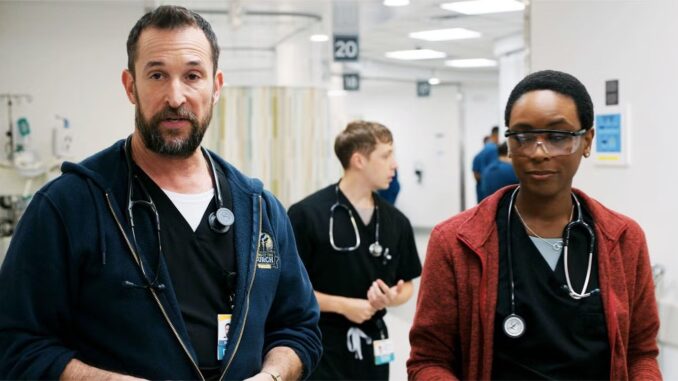
For decades, medical dramas have held a special place in the hearts of viewers. From breathtaking emergency cases and life-or-death decisions in seconds to the everyday stories behind the white coats, this genre has always had the ability to keep viewers on the edge of their seats and deeply moved.
The Pitt once again proved the enduring appeal of this genre. Instead of relying heavily on unrealistic dramatic plotlines, the series impresses by placing viewers right in the heart of the emergency room – where every alarm bell can reveal a story of life, loss, and hope.
The Pitt – a realistic look at the battle within the hospital.
The biggest difference of The Pitt lies in its approach to the medical profession.
Instead of focusing solely on talented doctors capable of solving every problem, the series portrays more realistic human beings: they are tired, under pressure, make mistakes, and sometimes have to make choices with no perfect answers.
The hospital in The Pitt isn’t just a place of triumphant moments.
It’s also a place of:
Patients who couldn’t be saved.
Families facing devastating news.
Doctors carrying the memories of each case.
Medical staff who must continue working despite their exhaustion.
It is this authenticity that makes viewers feel that behind every emergency case are real people.
Why do medical dramas always have such a special appeal?
1. Each episode feels like a battle for survival.
Unlike many other television genres, medical dramas naturally create a sense of urgency.
A patient walks through the emergency room door.
An emergency call rings.
A doctor has to make a decision in seconds.
These situations draw the viewer into the story immediately.
In The Pitt, every minute counts. A small decision can completely change a patient’s outcome.
2. Audiences Love Human Stories
Despite the hospital setting, the heart of medical dramas is never solely focused on medicine.
What keeps audiences engaged with series like The Pitt is the personal stories.
It could be a doctor struggling to overcome past trauma.
A nurse who is strong in front of patients but secretly endures personal pressure.
A young doctor learning to accept that effort isn’t always enough to save a life.
These stories allow viewers to see themselves in the characters.

Robby – The Imperfect Yet Reliable Doctor
At the heart of The Pitt is Dr. Michael “Robby” Robinavitch, a character who embodies the spirit of the series.
He is an experienced doctor who strives to protect his patients and lead his colleagues. But at the same time, Robby is a man deeply affected by his years working in a harsh environment.
What makes this character compelling isn’t that he’s always right.
But that he struggles.
He must find a balance between his professional responsibilities and his own limitations.
It’s a familiar theme in modern medical dramas: those who save lives also need care and healing.
From ER to Grey’s Anatomy and The Pitt: The Vitality of Medical Dramas
Television history has seen many medical dramas become phenomena.
ER changed the way audiences viewed hospital dramas with its fast pace and realistic storytelling.
Grey’s Anatomy made its mark by combining medicine, love, friendship, and the coming-of-age stories of doctors.
The Pitt, on the other hand, continued to develop a new direction: focusing on the real pressures of the emergency room and the people working in a system constantly pushed to its limits.
Each series has a different storytelling approach, but they all share the commonality of making viewers care about the people behind the medical profession.
Empathy – the key to the success of medical dramas
One important reason audiences love this genre is the emotional connection.
Everyone has needed to go to the hospital at some point.
Everyone has felt anxious while waiting for test results.
Everyone has witnessed the dedication of those working in the medical field.
Medical dramas touch upon very human experiences: fear, hope, loss, and gratitude.
The Pitt succeeded because the series didn’t just tell the story of doctors saving patients.
It tells the story of people trying to do the right thing in the most difficult circumstances.
The Future of Medical Dramas
The interest in The Pitt shows that audiences still love hospital stories. However, today’s viewers don’t just want to see tense surgeries or spectacular rescues.
They want to see the truth.
They want to understand the pressures that healthcare workers face.
They want to see the people behind the titles of doctor, nurse, or emergency room doctor.
And that may be why medical dramas will continue to exist.
Conclusion: Why do we still love The Pitt?
Because ultimately, The Pitt is not just a hospital story.
It’s a story about courage.
About people stepping into their shifts knowing they might face heartbreaking moments.
It’s about people who keep trying even when things don’t always end as they hoped.
And above all, it’s a story about people.
That’s what makes medical dramas one of the most enduring television genres – and why viewers keep waiting for the emergency bells to ring in the next episode.