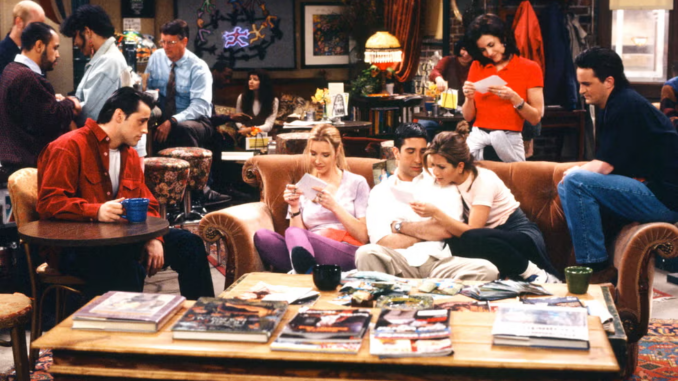
It’s awkward to admit, considering Friends and I have known each other for ages. In high school, it was my favorite show. I’d watch it in the background while doing homework (or pretending homework didn’t exist), while chatting with friends on the landline, or while avoiding some kind of family conflict. It made me believe that adulthood was basically a series of cappuccinos, nice apartments, and an emotionally unavailable man named Ross . It was warm. It was familiar. It was safe.
Now I’m enjoying a peaceful getaway, free from deadlines and the noise of the city. No tedious errands. I was so relaxed that my nervous system didn’t know what to do with itself. Naturally, I thought, “The perfect time to dust off that old comfort blanket.” Except the blanket felt thin.
I pressed play, hoping nostalgia would kick in. Instead, I found myself watching adults spiral into chaos as if the fate of civilization depended on whether someone said the wrong thing at Central Perk. A misunderstanding that could be resolved in 14,789 seconds becomes a full-blown identity crisis. A minor issue becomes the plot of an entire episode. I wasn’t loving it anymore. I felt uneasy.
Not because the jokes are “problematic” (that’s a whole other discussion). Not even because the pacing is dated. It’s because the stakes seem trivial in a way my adult brain can’t quite grasp. When you’re young, the stakes are trivial. Your world is small enough to make them seem enormous. Who likes you, who’s mad at you, who hasn’t answered you, who sits with whom. But adulthood doesn’t give you comedy problems. It gives you administrative problems. Money anxiety. Health issues. Career problems. Family dynamics. Constant imposter syndrome and the dread of “Am I wasting my potential?” and “Am I where I’m supposed to be?” The kind of stress that doesn’t end neatly at the 22-minute mark.

So seeing six adults treat indecisiveness as a personality type doesn’t hit the same note. It no longer feels comforting. It feels like a time capsule from a stage when your biggest fear was embarrassing yourself in front of people you wanted to impress.
Don’t get me wrong, I understand why it had us hooked. The fantasy wasn’t the jokes or the seemingly handed-to-you career paths all the characters had; it was the ecosystem. A group of friends always there for you. People who get together every day. A third place that isn’t work, home, or the inside of your phone. Problems that are aired out in real time and not saved in your Notes app under “things to deal with when I have a day off.” That’s the real anxiety of rewatching it now: it’s not that the series seems unrealistic, but that the world it presents seems increasingly strange. In 2026, adulthood is lonely. Calendars don’t align. Friendships have to survive reduced to voice notes.
So yes, I loved Friends . I grew up with it. It calmed me down. It taught me how to be sarcastic with conviction. And maybe that’s not so bad, maybe I’ve just changed . Comfort TV doesn’t always age with you. But it does remind you of who you were when comfort was easy, and that’s not a wound I’m willing to reopen. For now, I’m drawn to shows that understand the challenges, psychology, and chaos of adulthood.