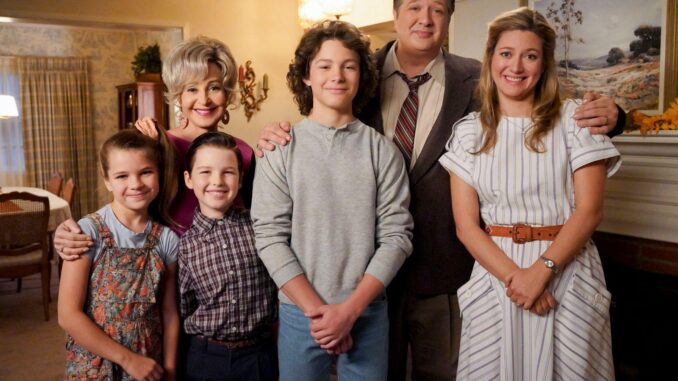
When Young Sheldon premiered in 2017, many fans assumed it would be little more than a nostalgic prequel—a chance to revisit Sheldon Cooper’s childhood before returning to the familiar world of The Big Bang Theory. Few imagined that the series would become one of the most important chapters in the franchise’s history.
Nearly a decade later, that perception has completely changed.
What began as the story of a brilliant child growing up in East Texas has evolved into the foundation of an expanding television universe. With Young Sheldon ending after seven successful seasons, Georgie & Mandy’s First Marriage continuing the Cooper family’s story, and the debut of HBO Max’s ambitious new series Stuart Fails to Save the Universe, the franchise has entered a bold new era unlike anything fans expected.
The remarkable part is that none of it would have been possible without Young Sheldon.
From a Simple Prequel to the Heart of the Franchise
When CBS announced Young Sheldon, expectations were relatively modest. The show had one obvious mission: explain how the awkward, socially challenged genius from The Big Bang Theory became the man audiences already knew.
Instead, the writers created something much larger.
Rather than focusing solely on Sheldon, the series invested deeply in the entire Cooper family. George Cooper transformed from a character once remembered mostly through Sheldon’s painful childhood stories into one of television’s most sympathetic fathers. Mary became far more complex than the overly protective mother fans remembered, while Meemaw evolved into one of the funniest and most beloved characters in the franchise.
Perhaps the biggest surprise came from Georgie and Missy.
Originally viewed as supporting characters, both developed into emotional anchors whose personal journeys often became just as compelling as Sheldon’s academic achievements. By the time the series reached its emotional finale, audiences weren’t watching simply to see what happened to Sheldon.
They were watching because they genuinely cared about the entire Cooper family.
That emotional investment completely changed the future of the franchise.
Georgie Proved the Story Didn’t End With Sheldon
The strongest evidence of Young Sheldon’s impact arrived almost immediately after the finale.
Instead of ending the Cooper family’s story, Warner Bros. and CBS launched Georgie & Mandy’s First Marriage, following Georgie as he balances marriage, parenthood, and adulthood after the events of Young Sheldon. The series demonstrates that audiences remain deeply invested in the Cooper family even when Sheldon is no longer the central character.
That decision would have seemed impossible when Young Sheldon first premiered.
Back then, Georgie was little more than the older brother Sheldon frequently underestimated. Over seven seasons, however, he became one of the franchise’s richest characters—a young man forced to grow up quickly after tragedy reshaped his family.
His spin-off proved something television executives rarely ignore.
Fans weren’t attached only to Sheldon Cooper.
They were attached to the world around him.
The Franchise Just Took Its Biggest Risk Yet
If Georgie & Mandy’s First Marriage expanded the emotional side of the universe, Stuart Fails to Save the Universe has completely reinvented its creative direction.
Unlike previous entries, the new HBO Max series moves beyond traditional family sitcom storytelling and embraces science fiction, alternate realities, and multiverse adventures. Stuart Bloom—the comic book store owner from The Big Bang Theory—unexpectedly becomes the unlikely hero after a device created by Sheldon and Leonard destabilizes reality itself.
It is easily the most ambitious project the franchise has ever attempted.
The series introduces alternate versions of familiar characters, unexpected cameos, and a far more cinematic style than anything viewers have previously associated with The Big Bang Theory. Even creator Chuck Lorre admitted that choosing Stuart as the lead was intentionally unconventional because he wanted to challenge audience expectations rather than repeat old formulas.
For longtime fans, the message is clear.
This universe is no longer afraid to experiment.
Why Fans Suddenly Believe Anything Is Possible
The expansion of the franchise has reignited speculation across fan communities.
For years, discussions centered on whether Young Sheldon might receive an eighth season.
Today, the conversation has changed.
Instead of asking whether the series will return, fans are wondering which characters might appear next.
Could Georgie cross paths with Stuart?
Will Missy eventually receive her own story?
Might Mary or Meemaw make future guest appearances?
Could an older Sheldon unexpectedly return in a crossover event?
None of these possibilities have been officially announced, but the existence of multiple interconnected series has made them feel far more realistic than they once did.
Shared universes naturally create opportunities for reunions, and audiences know it.
Streaming Has Created a Whole New Audience
Another reason the franchise continues growing is the arrival of new viewers through streaming platforms.
Unlike fans who watched Young Sheldon over seven years, today’s audiences often experience the entire series within a matter of weeks. They witness George Cooper’s heartbreaking death, Georgie’s transformation into the family’s protector, and Sheldon’s departure for college in rapid succession.
The emotional impact is immense.
Once they finish the finale, many immediately search for what comes next.
Instead of finding an empty franchise, they discover multiple new series continuing different corners of the same universe.
That constant flow of new fans ensures that Young Sheldon remains just as relevant today as it was during its original broadcast.
The Cooper Family’s Legacy Is Bigger Than Anyone Expected
Perhaps the greatest achievement of Young Sheldon is that it permanently changed how audiences define the franchise.
Before the prequel, The Big Bang Theory was remembered primarily for its brilliant scientists and clever humor.
After Young Sheldon, it also became a story about family.
About George trying to become a better father.
About Mary’s unwavering faith.
About Missy’s search for her own identity.
About Georgie’s unexpected maturity.
Those emotional foundations gave later spin-offs something invaluable: characters worth revisiting.
Without the Cooper family, the franchise might never have grown beyond its original sitcom.
Instead, it became a living universe capable of supporting entirely new stories.
Final Thoughts
Television spin-offs often struggle to escape the shadow of the series that inspired them.
Young Sheldon accomplished something far more impressive.
It didn’t simply honor The Big Bang Theory.
It strengthened it.
By introducing unforgettable new characters, deepening familiar relationships, and proving that audiences cared about far more than Sheldon Cooper alone, the series laid the foundation for an expanding television universe that continues to surprise fans.
Today, Georgie & Mandy’s First Marriage carries the emotional legacy of the Cooper family, while Stuart Fails to Save the Universe pushes the franchise into bold new creative territory. Together, they demonstrate that the world first expanded by Young Sheldon is still evolving.
The final episode of Young Sheldon may have closed one chapter.
But it also opened the door to a much bigger universe—one that shows no sign of slowing down.